

Another Word For Marginal Cost
In economic science, the marginal toll is the modify in the total cost that arises when the quantity produced is incremented, the cost of producing additional quantity.[1] In some contexts, it refers to an increment of ane unit of output, and in others it refers to the rate of change of total cost as output is increased by an infinitesimal amount. As Figure 1 shows, the marginal cost is measured in dollars per unit, whereas total cost is in dollars, and the marginal toll is the slope of the total cost, the rate at which it increases with output. Marginal price is unlike from average price, which is the total cost divided by the number of units produced.
At each level of production and time period being considered, marginal toll includes all costs that vary with the level of production, whereas costs that practice non vary with production are stock-still. For case, the marginal cost of producing an motorcar will include the costs of labor and parts needed for the additional automobile just not the stock-still price of the factory building that practise not modify with output. The marginal toll tin can be either short-run or long-run marginal price, depending on what costs vary with output, since in the long run even building size is chosen to fit the desired output.
If the cost function is continuous and differentiable, the marginal cost is the first derivative of the cost office with respect to the output quantity :[two]


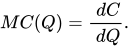
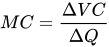
If the toll role is non differentiable, the marginal cost can be expressed every bit follows:
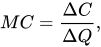
where denotes an incremental alter of one unit.

Short run marginal price [edit]

Short run marginal cost is the change in total toll when an boosted output is produced in the short run and some costs are fixed. On the right side of the page, the short-run marginal toll forms a U-shape, with quantity on the x-axis and price per unit of measurement on the y-centrality.
On the brusque run, the firm has some costs that are fixed independently of the quantity of output (e.g. buildings, machinery). Other costs such as labor and materials vary with output, and thus show upwards in marginal price. The marginal cost may showtime decline, equally in the diagram, if the additional cost per unit is high if the business firm operates at too low a level of output, or it may start apartment or rise immediately. At some indicate, the marginal cost rises as increases in the variable inputs such as labor put increasing force per unit area on the stock-still assets such every bit the size of the building. In the long run, the business firm would increase its fixed avails to correspond to the desired output; the short run is defined every bit the flow in which those assets cannot be changed.
Long run marginal cost [edit]
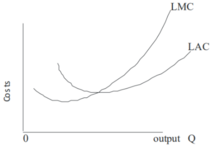
The long run is defined every bit the length of time in which no input is stock-still. Everything, including building size and machinery, can be chosen optimally for the quantity of output that is desired. Equally a result, even if short-run marginal cost rises because of capacity constraints, long-run marginal cost can be constant. Or, there may exist increasing or decreasing returns to scale if technological or direction productivity changes with the quantity. Or, there may be both, equally in the diagram at the right, in which the marginal cost first falls (increasing returns to calibration) and and so rises (decreasing returns to calibration).[3]
Cost functions and relationship to average toll [edit]
In the simplest case, the total cost function and its derivative are expressed as follows, where Q represents the production quantity, VC represents variable costs, FC represents stock-still costs and TC represents total costs.
Fixed costs represent the costs that practice non change as the production quantity changes. Fixed costs are costs incurred past things like hire, building space, machines, etc. Variable costs change equally the production quantity changes, and are oft associated with labor or materials. The derivative of fixed cost is zero, and this term drops out of the marginal cost equation: that is, marginal cost does non depend on fixed costs. This can exist compared with average total cost (ATC), which is the total cost (including fixed costs, denoted C0) divided by the number of units produced:
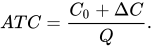
For discrete calculation without calculus, marginal price equals the alter in total (or variable) cost that comes with each additional unit of measurement produced. Since fixed price does not change in the short run, it has no event on marginal cost.
For instance, suppose the total price of making ane shoe is $thirty and the total toll of making 2 shoes is $40. The marginal cost of producing shoes decreases from $30 to $x with the product of the 2nd shoe ($forty – $30 = $10).
Marginal cost is not the cost of producing the "next" or "last" unit.[4] The cost of the last unit is the aforementioned as the toll of the beginning unit and every other unit. In the brusque run, increasing production requires using more of the variable input — conventionally causeless to be labor. Adding more labor to a fixed capital stock reduces the marginal product of labor because of the diminishing marginal returns. This reduction in productivity is not limited to the boosted labor needed to produce the marginal unit – the productivity of every unit of measurement of labor is reduced. Thus the price of producing the marginal unit of output has two components: the cost associated with producing the marginal unit and the increase in average costs for all units produced due to the "damage" to the entire productive process. The showtime component is the per-unit or average cost. The 2nd component is the small increment in cost due to the law of diminishing marginal returns which increases the costs of all units sold.
Marginal costs can also exist expressed as the cost per unit of labor divided past the marginal product of labor.[v] Cogent variable cost equally VC, the constant wage rate as w, and labor usage as L, nosotros take

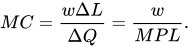
Here MPL is the ratio of increase in the quantity produced per unit of measurement increase in labour: i.e. ΔQ/ΔL, the marginal product of labor. The last equality holds because is the change in quantity of labor that brings nigh a 1-unit of measurement change in output.[6] Since the wage rate is assumed constant, marginal cost and marginal production of labor have an changed relationship—if the marginal product of labor is decreasing (or, increasing), then marginal toll is increasing (decreasing), and AVC = VC/Q=wL/Q = w/(Q/L) = w/APL

Empirical data on marginal cost [edit]
While neoclassical models broadly assume that marginal toll will increase as product increases, several empirical studies conducted throughout the 20th century have concluded that the marginal cost is either abiding or falling for the vast majority of firms.[vii] About recently, onetime Federal Reserve Vice-Chair Alan Blinder and colleagues conducted a survey of 200 executives of corporations with sales exceeding $10 million, in which they were asked, among other questions, about the construction of their marginal cost curves. Strikingly, just eleven% of respondents answered that their marginal costs increased as production increased, while 48% answered that they were abiding, and 41% answered that they were decreasing.[8] : 106 Summing upward the results, they wrote:
...many more companies state that they accept falling, rather than rising, marginal toll curves. While there are reasons to wonder whether respondents interpreted these questions about costs correctly, their answers paint an image of the cost construction of the typical firm that is very different from the 1 immortalized in textbooks.
— Asking About Prices: A New Approach to Agreement Price Stickiness, p. 105[8]
Many Postal service-Keynesian economists have pointed to these results as testify in favor of their own heterodox theories of the firm, which generally assume that marginal cost is constant as production increases.[7]
Economies of calibration [edit]
Economies of scale apply to the long run, a span of time in which all inputs can be varied past the firm and so that there are no fixed inputs or stock-still costs. Production may exist subject to economies of calibration (or diseconomies of scale). Economies of scale are said to be if an boosted unit of output can be produced for less than the average of all previous units – that is, if long-run marginal toll is beneath long-run average cost, and then the latter is falling. Conversely, there may be levels of production where marginal cost is higher than average cost, and the average cost is an increasing function of output. Where at that place are economies of scale, prices set at marginal cost will fail to embrace total costs, thus requiring a subsidy.[ix] For this generic example, minimum average price occurs at the signal where average price and marginal cost are equal (when plotted, the marginal cost curve intersects the boilerplate cost curve from below).
Perfectly competitive supply bend [edit]
The portion of the marginal cost curve to a higher place its intersection with the average variable cost bend is the supply bend for a business firm operating in a perfectly competitive market (the portion of the MC curve below its intersection with the AVC curve is non role of the supply curve because a business firm would non operate at a cost below the shutdown point). This is non true for firms operating in other market structures. For example, while a monopoly has an MC curve, information technology does not accept a supply curve. In a perfectly competitive market, a supply curve shows the quantity a seller is willing and able to supply at each price – for each price, there is a unique quantity that would be supplied.
Decisions taken based on marginal costs [edit]
In perfectly competitive markets, firms determine the quantity to be produced based on marginal costs and auction price. If the sale price is higher than the marginal cost, then they produce the unit and supply it. If the marginal toll is higher than the cost, it would not be profitable to produce it. And so the production will be carried out until the marginal cost is equal to the auction price.[10]
Relationship to stock-still costs [edit]
Marginal costs are non affected by the level of stock-still cost. Marginal costs tin can exist expressed as ∆C/∆Q. Since fixed costs do non vary with (depend on) changes in quantity, MC is ∆VC/∆Q. Thus if fixed cost were to double, the marginal cost MC would non be affected, and consequently, the profit-maximizing quantity and cost would non modify. This tin exist illustrated by graphing the brusk run full toll bend and the short-run variable cost curve. The shapes of the curves are identical. Each bend initially increases at a decreasing charge per unit, reaches an inflection betoken, then increases at an increasing rate. The simply difference between the curves is that the SRVC curve begins from the origin while the SRTC curve originates on the positive part of the vertical axis. The distance of the beginning point of the SRTC to a higher place the origin represents the fixed cost – the vertical altitude between the curves. This distance remains abiding as the quantity produced, Q, increases. MC is the slope of the SRVC curve. A change in stock-still cost would exist reflected by a change in the vertical distance between the SRTC and SRVC bend. Any such change would take no effect on the shape of the SRVC bend and therefore its slope MC at whatsoever indicate. The irresolute law of marginal cost is like to the changing law of boilerplate cost. They are both decrease at first with the increase of output, and so start to increase after reaching a certain calibration. While the output when marginal cost reaches its minimum is smaller than the average total cost and boilerplate variable cost. When the average full cost and the average variable price accomplish their lowest betoken, the marginal toll is equal to the boilerplate price.
[edit]
Of not bad importance in the theory of marginal cost is the distinction between the marginal private and social costs. The marginal individual cost shows the cost borne by the firm in question. It is the marginal private cost that is used by business decision makers in their turn a profit maximization behavior. Marginal social cost is similar to private price in that it includes the price of private enterprise but too any other cost (or offsetting do good) to parties having no direct association with purchase or sale of the product. Information technology incorporates all negative and positive externalities, of both production and consumption. Examples include a social cost from air pollution affecting third parties and a social benefit from flu shots protecting others from infection.
Externalities are costs (or benefits) that are not borne by the parties to the economic transaction. A producer may, for example, pollute the environment, and others may bear those costs. A consumer may eat a good which produces benefits for social club, such as education; because the individual does not receive all of the benefits, he may consume less than efficiency would advise. Alternatively, an individual may be a smoker or alcoholic and impose costs on others. In these cases, production or consumption of the good in question may differ from the optimum level.
Negative externalities of production [edit]

Negative Externalities of Production
Much of the time, individual and social costs do not diverge from one some other, but at times social costs may exist either greater or less than private costs. When the marginal social cost of production is greater than that of the individual cost function, there is a negative externality of production. Productive processes that result in pollution or other environmental waste material are textbook examples of production that creates negative externalities.
Such externalities are a effect of firms externalizing their costs onto a third party in order to reduce their ain full cost. Equally a result of externalizing such costs, we run across that members of society who are not included in the business firm will be negatively afflicted by such behavior of the firm. In this example, an increased toll of production in society creates a social toll curve that depicts a greater cost than the private cost curve.
In an equilibrium state, markets creating negative externalities of production will overproduce that good. As a result, the socially optimal production level would be lower than that observed.
Positive externalities of production [edit]

Positive Externalities of Production
When the marginal social cost of production is less than that of the private cost function, there is a positive externality of production. Production of public appurtenances is a textbook example of production that creates positive externalities. An case of such a public good, which creates a divergence in social and individual costs, is the production of education. It is often seen that didactics is a positive for any whole lodge, as well as a positive for those directly involved in the market.
Such product creates a social price curve that is beneath the private cost bend. In an equilibrium country, markets creating positive externalities of production volition underproduce their good. Every bit a effect, the socially optimal production level would be greater than that observed.
Human relationship betwixt marginal price and average full price [edit]
The marginal toll intersects with the average total cost and the average variable cost at their lowest signal. Take the [Relationship between marginal toll and boilerplate total cost] graph as a representation.

Relationship betwixt marginal cost and boilerplate total price
Say the starting betoken of level of output produced is north. Marginal toll is the change of the total cost from an boosted output [(north+one)th unit]. Therefore, (refer to "Average toll" labelled picture on the right side of the screen.

In this case, when the marginal cost of the (n+1)th unit is less than the average cost(due north), the boilerplate cost (north+ane) will get a smaller value than boilerplate toll(due north). It goes the opposite way when the marginal price of (n+1)thursday is higher than average cost(n). In this example, The boilerplate cost(n+1) volition be higher than average price(north). If the marginal toll is institute lying under the boilerplate cost curve, it volition bend the average toll bend downwards and if the marginal cost is above the average cost curve, it will bend the average cost curve upward. You can encounter the table above where before the marginal price bend and the boilerplate cost curve intersect, the boilerplate cost curve is downwards sloping, however afterwards the intersection, the average cost curve is sloping upwards. The U-shape graph reflects the law of diminishing returns. A firm tin can only produce and then much but subsequently the product of (due north+i)th output reaches a minimum cost, the output produced after will just increment the boilerplate total cost (Nwokoye, Ebele & Ilechukwu, Nneamaka, 2018).
Profit maximization [edit]
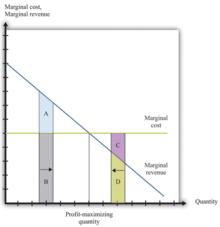
The profit maximizing graph on the right side of the page represents optimal production quantity when both The marginal cost and the marginal profit line intercepts. The Blackness line represents the intersection where the profits are the greatest ( Marginal revenue = marginal cost). The left side of the black vertical line marked as "profit-maximising quantity" is where the marginal acquirement is larger than marginal cost. If a firm sets its product on the left side of the graph and decides to increase the output, the additional acquirement per output obtained will exceed the boosted price per output. From the "profit maximizing graph", we could observe that the acquirement covers both bar A and B, meanwhile the cost simply covers B. Of course A+B earns you a profit just the increase in output to the point of MR=MC yields extra turn a profit that can cover the revenue for the missing A. The firm is recommended to increment output to reach (Theory and Applications of Microeconomics, 2012).
On the other hand, the right side of the black line (Marginal revenue = marginal toll), shows that marginal cost is more than than marginal revenue. Suppose a firm sets its output on this side, if it reduces the output, the cost will subtract from C and D which exceeds the subtract in acquirement which is D. Therefore, decreasing output until the point of (marginal acquirement=marginal toll) volition lead to an increment in profit (Theory and Applications of Microeconomics, 2012).
Run into besides [edit]
- Boilerplate toll
- Break even analysis
- Price
- Cost curve
- Cost-Volume-Profit Analysis
- Cost-sharing mechanism
- Economic surplus
- Marginal concepts
- Marginal factor cost
- Marginal product of labor
- Marginal revenue
- Merit goods
References [edit]
- ^ O'Sullivan, Arthur; Sheffrin, Steven K. (2003). Economics: Principles in Action . Upper Saddle River, NJ: Pearson Prentice Hall. p. 111. ISBN0-13-063085-3.
- ^ Simon, Carl; Blume, Lawrence (1994). Mathematics for Economists. West. Westward. Norton & Company. ISBN0393957330.
- ^ The classic reference is Jakob Viner, "Cost Curves and Supply Curve," Zeitschrift fur Nationalokonomie, iii:23-46 (1932).
- ^ Silberberg & Suen, The Structure of Economics, A Mathematical Assay 3rd ed. (McGraw-Hill 2001) at 181.
- ^ Run across http://ocw.mit.edu/courses/economics/14-01-principles-of-microeconomics-fall-2007/lecture-notes/14_01_lec13.pdf.
- ^ Chia-Hui Chen, class materials for 14.01 Principles of Microeconomics, Fall 2007. MIT OpenCourseWare (http://ocw.mit.edu), Massachusetts Plant of Technology. Downloaded on [12 Sept 2009].
- ^ a b Lavoie, Marc (2014). Mail-Keynesian Economics: New Foundations. Northampton, MA: Edward Elgar Publishing, Inc. p. 151. ISBN978-i-84720-483-7.
- ^ a b Blinder, Alan S.; Canetti, Elie R. D.; Lebow, David E.; Rudd, Jeremy B. (1998). Request Well-nigh Prices: A New Arroyo to Agreement Price Stickiness. New York: Russell Sage Foundation. ISBN0-87154-121-i.
- ^ Vickrey W. (2008) "Marginal and Average Cost Pricing". In: Palgrave Macmillan (eds) The New Palgrave Dictionary of Economics. Palgrave Macmillan, London[ ISBN missing ]
- ^ "Piana V. (2011), Refusal to sell – a primal concept in Economics and Management, Economics Spider web Institute."
External links [edit]
- Bio, Full (2021-05-19). "Marginal Cost Of Production Definition". Investopedia . Retrieved 2021-05-28 .
- Nwokoye, Ebele Stella; Ilechukwu, Nneamaka (2018-08-06). "CHAPTER V THEORY OF COSTS". ResearchGate . Retrieved 2021-05-28 .
- "Theory and Applications of Microeconomics - Tabular array of Contents". 2012 Volume Annal. 2012-12-29. Retrieved 2021-05-28 .

Another Word For Marginal Cost,
Source: https://en.wikipedia.org/wiki/Marginal_cost
Posted by: rosenbergirint1980.blogspot.com
0 Response to "Another Word For Marginal Cost"
Post a Comment